
From Employed Tradie to Booked-Solid Business Owner: Newton's Story
Apr 12, 2026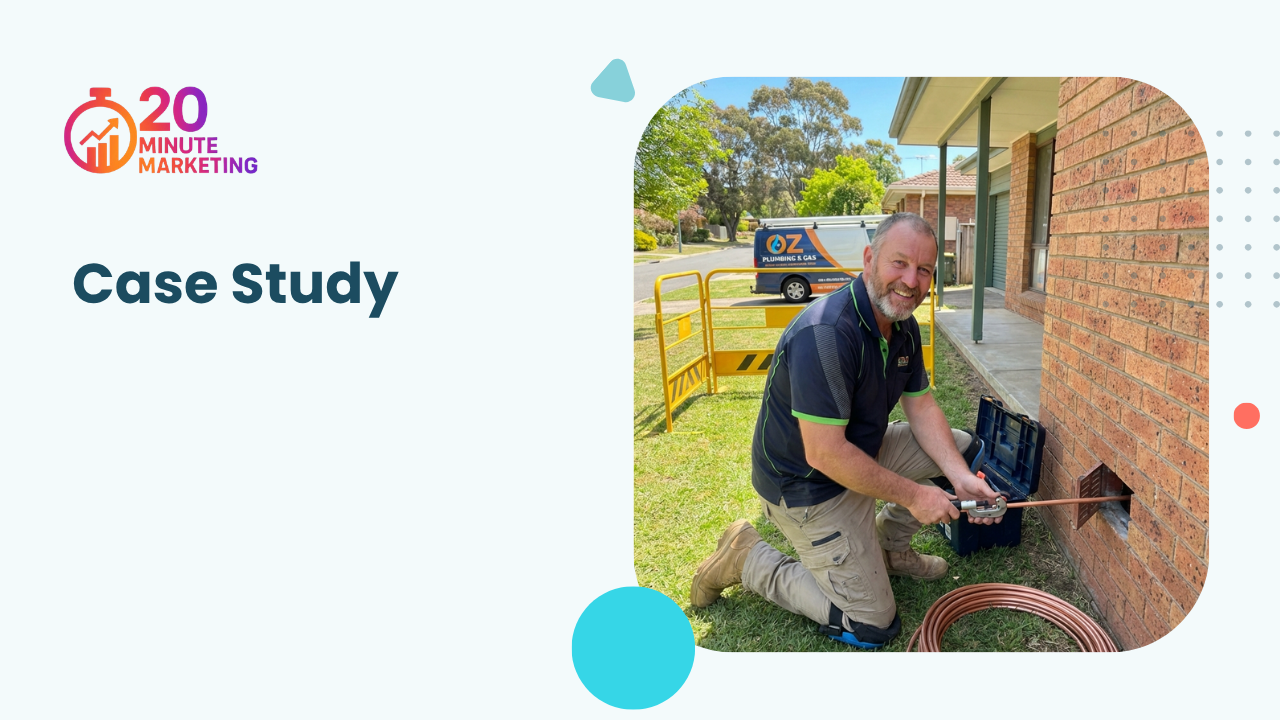
Last updated: April 2026 · Written by 20 Minute Marketing · 9 min read
Student Case Study · April 2026 · 12 min read
Six months after leaving a national plumbing chain to go out on his own, Newton is almost back to his previous salary. Within a year, he expects to comfortably exceed it with his business, Newton Plumbing, a specialist in areas like Blackburn and Glen Waverley
He's booked two weeks out. He's stopped relying on bidding sites entirely. And the majority of his work comes from within a few kilometres of his home — meaning more jobs per day, less time in traffic, and a better effective hourly rate than he's ever earned.
He built his entire digital presence himself: a Squarespace website he designed, a Google Business Profile he optimised from scratch, and a local SEO strategy he learned in 20-minute lessons between jobs. Here's exactly how he did it.
At a Glance
📘 Want the full picture? Read our digital marketing for small business — the complete pillar guide this article is part of.
| Name | Newton |
| Business | Independent plumbing business — sole operator |
| Location | Melbourne's eastern suburbs |
| Background | Qualified plumber, previously employed by a national plumbing chain for 7 years |
| Starting point | Zero digital presence — no website, no GBP, no reviews, no email list, no business name |
| Courses completed | 20 Minute Marketing Essentials Course + Email & SMS Short Course |
| Time to results | Meaningful enquiry volume within 8 weeks · Close to previous salary by month 6 |
The Results
|
~90% of previous salary reached by month 6 |
100% booked — 2 weeks out by month 5 |
$0 spent on HiPages or bidding sites by month 4 |
+3–4 extra jobs per week from geographic SEO |
The Problem: Starting From Zero
Newton spent seven years working for a national plumbing franchise. He was good at his job, built a strong reputation in the eastern suburbs, and eventually reached the point where he was doing the work, managing client relationships, and troubleshooting complex jobs — while the business he worked for kept the margin.
"I knew I was worth more than I was earning. But when I thought about going out on my own, the thing that scared me wasn't the plumbing — it was the marketing. I'd always had jobs come through the company. I had no idea how to make the phone ring myself."
When Newton registered his ABN and launched, he had no website, no Google Business Profile, no social media presence, and no online reviews. His only marketing was word of mouth from contacts he'd built over seven years. For the first six weeks, that generated a trickle of work — enough to survive, not enough to build a business on.
"I was spending hours every week on HiPages and Gumtree, quoting on jobs I wasn't winning, against other tradies I was undercutting myself to beat. I was working hard and going backwards."
"I was quoting on 15 jobs to win 3. I knew there had to be a better way."
The Turning Point: Learning Strategy, Not Just Tactics
Newton found 20 Minute Marketing through a Google search — ironically, while trying to figure out SEO himself from a patchwork of free tutorials. He enrolled in the Essentials Course.
"The free stuff I'd found online was all over the place. Some of it was American, some of it was years out of date, and none of it connected into a strategy. The 20 Minute Marketing course was the first time it all made sense as a system — not just individual tips."
The 20-minute format was a specific fit for Newton's situation. He was doing physical work during the day and had limited energy for extended study in the evening.
"Twenty minutes is genuinely 20 minutes. I was doing two or three lessons a week, usually in my car after a job or over lunch. It didn't feel like going back to school. It felt like getting smarter about something I was already doing."
What Newton Built — Step by Step
A Website Built for Local Search
Newton's first priority was a website. He chose Squarespace for ease of use and built it himself, applying the SEO principles from the course in real time. Rather than building a generic plumbing website, he structured it around the specific local searches his potential customers were making.
He created individual landing pages for each core service in each suburb he wanted to target:
| Plumber Ringwood | Dedicated page with localised content, suburb-specific language, and service details |
| Emergency plumber eastern suburbs | Urgent-intent page with direct messaging and prominent call to action above the fold |
| Hot water system replacement Mitcham | High-value service page targeting a specific job type in a specific area |
| Burst pipe plumber Knox | Emergency-intent page for a specific council area |
Within six weeks of launching, three of his suburb-specific pages were ranking on page one of Google for their target keywords. Within three months, the majority were.
"I'm not ranking for 'plumber Melbourne.' I don't want to. I'm ranking for 'plumber Ringwood' and 'plumber Croydon' — and those are the jobs I want."
Google Business Profile — Treated as a Primary Marketing Channel
Newton set up his GBP in week one, but it was the GBP optimisation module in the Essentials Course that showed him how far most tradies were leaving it underdeveloped.
"Most GBP profiles I'd seen from other tradies were barely filled out. I spent a full Saturday doing mine properly — every section, every service listed, every attribute ticked, before and after photos I'd had on my phone for years uploaded, correct categories. It took about five hours total."
A Review Generation System That Runs Itself
Newton understood early that Google reviews are both a ranking signal and a conversion signal — the first thing a potential customer reads after finding him in Google Maps. He built a systematic process for generating them.
The Email & SMS short course gave him the framework: every job completion triggers an SMS thank-you within two hours, followed by an email 24 hours later with a direct link to leave a Google review. Brief, personalised, frictionless.
| Before the system | Reviews from roughly 1 in 15 customers |
| After the system | Reviews from roughly 1 in 4 customers |
Newton reached 40 Google reviews within four months — a number that typically takes independent tradies two to three years through passive collection. The review volume pushed him into the top three positions on Google Maps for most of his target suburbs.
★★★★★ — Google Review, Croydon
"Newton is by far the best plumber I've found in the eastern suburbs. Responded within the hour, fixed the problem the same day, and was incredibly professional throughout. Will use again for everything."
Email and SMS — Keeping Customers for Life
Every customer who booked a job was added to Newton's email and SMS list from day one. Every job completion sent an automated thank-you sequence. Every three months, his list received a short, practical email — seasonal maintenance reminders, tips about preventing common plumbing issues, or a heads-up about his availability.
"The email list is probably the thing that surprised me most. I'd never thought of a plumber as someone who sends marketing emails. But they're not marketing emails — they're useful emails. People actually open them. And when they need a plumber, we're top of mind."
Real example: A customer responded to Newton's three-month maintenance email saying she'd been meaning to get her hot water system looked at. That was a $2,400 job from an email that cost nothing to send.
Geographic SEO — Working Smarter, Not Harder
Newton's SEO strategy contains a detail that most marketing advice misses entirely: he's not trying to get all the work in Melbourne. He's trying to get all the work near home.
His suburb-specific landing pages are concentrated within a roughly 10–15 kilometre radius of where he lives. Not because he can't work elsewhere — but because he understands the maths.
"Travel time is dead time. I'm not getting paid to sit in traffic. If I can do five jobs in Ringwood and Croydon in a day instead of three jobs spread across Melbourne, I'm earning more even if the individual job rates are the same."
Ditching HiPages and Taking Control
By month four, Newton had effectively stopped using HiPages. Not as a deliberate decision — but because the enquiry volume coming through his own channels had made the bidding sites redundant.
"HiPages was a race to the bottom. You're quoting blind against three other tradies, someone's always cheaper, and the customers you win aren't loyal — they'll go back to the site next time and find someone cheaper again. It's not how I want to build a business."
| HiPages / Bidding Sites | Own Digital Presence | |
|---|---|---|
| Lead cost | $25–$80+ per lead | $0 per lead (ongoing) |
| Competitive pressure | High — quoting against 4–6 others simultaneously | Low — customer chose Newton before calling |
| Quote acceptance rate | ~20% (won 3 of 15 quotes) | ~70%+ (customer pre-sold by reviews) |
| Customer loyalty | Low — transactional, price-driven | High — relationship-based, on email list |
The Pricing Shift — What Happens When Demand Exceeds Supply
By month five, Newton was facing a situation he hadn't anticipated: he had more enquiries than he could take on. His pipeline was full. He was turning work away.
His response was straightforward: he raised his rates.
"When I was on HiPages, I was competing on price. I had to be cheap to win jobs. Now I'm fully booked and turning work away — which means the market is telling me my rates are too low. So I put them up."
Newton increased his standard call-out rate by 15% in month five and saw no meaningful reduction in bookings. His quote acceptance rate on new enquiries remained above 70% — well above the industry average — because customers arriving through his Google presence had already read 40+ five-star reviews and made a decision before the call.
"People aren't calling me to get a cheap quote anymore. They're calling me because they've already decided they want me. That changes every conversation."
The Six-Month Picture
| Metric | Six-Month Result |
|---|---|
| Revenue | ~90% of previous employed salary — and accelerating |
| Pipeline | Fully booked two weeks out; turning away work |
| Lead sources | Predominantly Google organic and Google Maps; Google Ads used selectively for high-margin jobs only |
| Bidding sites | HiPages, Gumtree — reduced to zero |
| Review profile | 40+ Google reviews at 4.9 average; consistently ranking top 3 on Google Maps in target suburbs |
| Geographic efficiency | 80%+ of jobs within 15km of home; 4–5 jobs per day vs 3 previously |
| Email/SMS database | 180+ contacts; automated review requests and seasonal maintenance campaigns running |
"I'll clear my previous salary within the year and I'll never go back. Not because the plumbing is different — it's the same work. But because now I understand how to market it."
What Newton Would Tell Other Tradies
| 1 | "Start with Google Business Profile." Before you touch your website, before you think about ads, before you do anything else — do your GBP properly. One Saturday, five hours. It's the single highest-ROI thing I did. |
| 2 | "Build suburb-specific landing pages." The suburb pages were the thing that took me from getting found to getting found by the right people. Generic plumbing websites don't rank for local searches. You need a page that's about Ringwood if you want to rank for Ringwood. |
| 3 | "Build a review system, not just a review count." Not one individual review — the system. Asking every customer, at the right time, with a direct link. It takes five minutes to set up and it runs itself. |
| 4 | "Stop giving your margin to HiPages." Every dollar you pay them is a dollar you could have spent building your own presence, which compounds forever. HiPages money is gone the moment you spend it. SEO builds an asset. |
| 5 | "The 20-minute format is real." I have a mate who tried to learn this stuff from YouTube for months and gave up. I did it in the van between jobs. The format is the thing that makes it possible for someone actually running a business. |
Build the digital presence Newton built — in 20 minutes at a time
The 20 Minute Marketing Essentials Course covers everything Newton used: Google Business Profile, local SEO, suburb-specific landing pages, review velocity, and email and SMS marketing. 53 lessons. $499 one-off, with 12 months access.
Start the Essentials Course →Frequently Asked Questions
How long does it take for a Google Business Profile to start generating leads?
For most local trade businesses, a properly optimised Google Business Profile starts generating phone calls and direction requests within 2–4 weeks of completion. Newton saw his first GBP-driven enquiries within two weeks of completing his optimisation. The key word is "optimised" — a bare-minimum profile with just a business name and phone number may take months or never gain traction. Every section filled out, services listed, photos uploaded, and correct categories selected is what triggers the algorithm.
How many Google reviews do you need to rank in the local pack?
There's no fixed number, but in most local trade markets, 15–20 reviews with a 4.5+ average is enough to compete for the local pack. Newton reached 40 reviews in four months, which pushed him into the top three for most of his target suburb searches. Equally important is review recency — a business with 100 reviews from three years ago often ranks below one with 30 reviews from the past six months.
Is local SEO worth it for a sole trader tradie just starting out?
It's the highest-ROI marketing activity available to a sole trader tradie, specifically because it targets people who are actively searching for your service right now — not people you're interrupting with ads. A plumber ranking on page one for "plumber Ringwood" is visible to everyone in Ringwood who searches that term, indefinitely, at zero ongoing cost per click. Newton's investment was time to learn the strategy and a Saturday to build his GBP. That investment now generates more leads than he can take on.
What's the best alternative to HiPages for tradies?
Your own Google Business Profile and a website with suburb-specific landing pages. Newton's case study shows that once your own digital presence is established, bidding sites become redundant — and the economics are dramatically better. A HiPages lead costs $25–$80 and arrives in a competitive quote situation. A lead from your own Google presence costs nothing and arrives having already decided they want you. The upfront investment is time to build the system; the ongoing return is compounding.
How do suburb-specific landing pages work for local SEO?
Each page targets a specific keyword combination — typically "[service] + [suburb]" — and contains content that genuinely addresses what someone searching that term is looking for. Google's algorithm is trying to match the most relevant result to each search query. A page specifically about plumbing in Ringwood, with local references, a Ringwood service area mentioned, and the business's GBP address signals, is more relevant to "plumber Ringwood" than a generic plumbing page that mentions suburbs once in passing. Newton built individual pages for each target suburb and each core service, creating a matrix of hyper-local pages that between them cover the specific searches his ideal customers make.
Get the complete digital marketing system built for Australian small business.
See the Essentials Course →Marketing built for businesses like yours.
Our digital marketing course is designed for time-poor small business owners — practical, jargon-free, and proven across trades, services and retail.
Built for time-poor Australian small business owners.
Learn digital marketing in 20 minutes a day
Self-paced courses from someone who runs digital for two national brands. Build skills you can show an employer or a client.