Customer Journey Digital Marketing: Why Most Businesses Get It Wrong (And How to Fix It)
May 12, 2025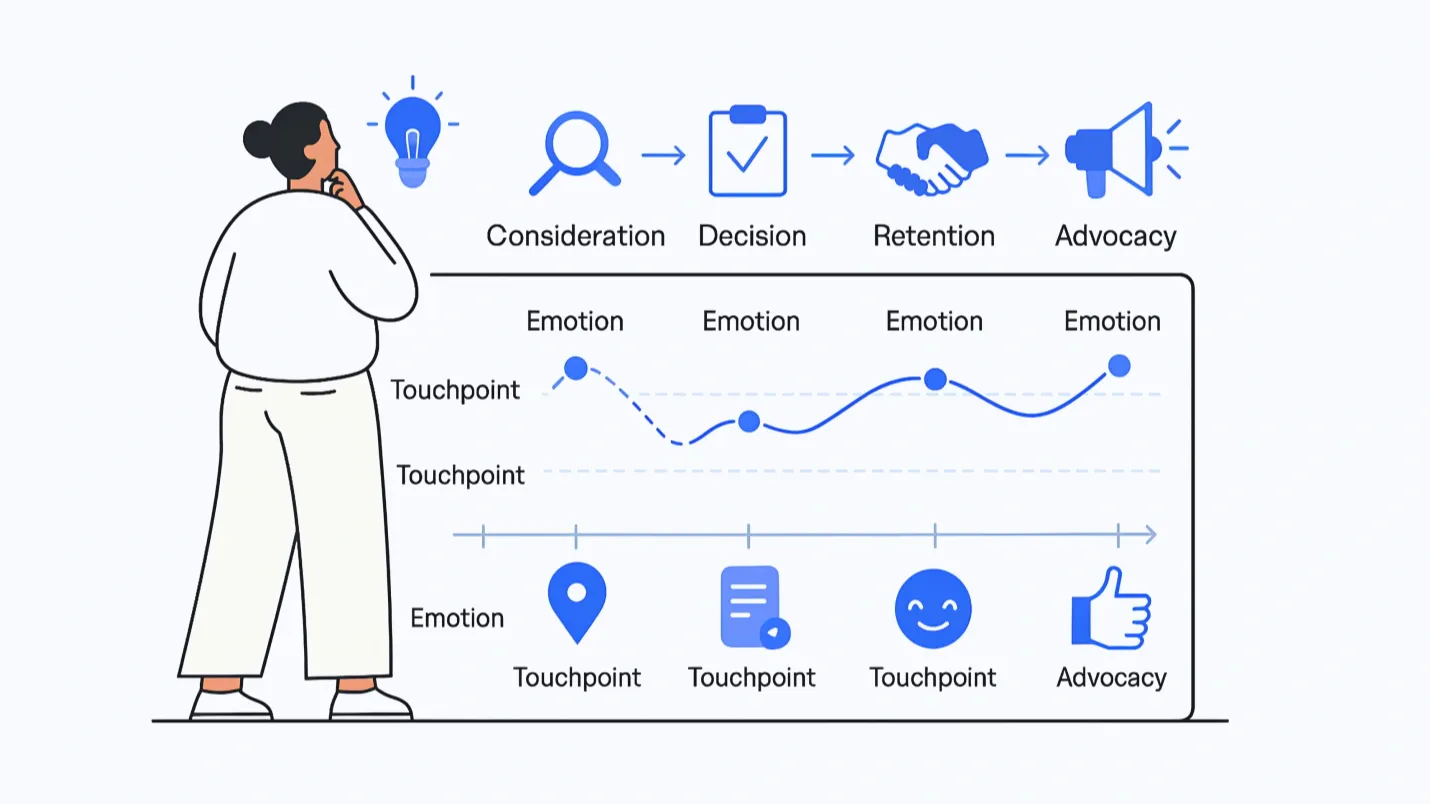
Last updated: April 2026 · Written by 20 Minute Marketing · 9 min read
Here's something most business owners get wrong about digital marketing:
They think it's about the tools.
They focus on getting the perfect Instagram aesthetic. They obsess over Google Ads algorithms. They chase the latest social media trends. They optimize every pixel of their website.
But they miss the most critical element: understanding the journey their customers actually take.
The reality is this: Your customer doesn't care about your tools. They care about solving their problem.
And their journey to solving that problem looks completely different than it did 10 years ago. They're not waiting passively for your ads. They're actively searching, researching, comparing, and deciding—mostly online—before they ever contact you.
If you don't understand that journey, you'll keep missing opportunities. You'll spend money on the wrong channels. You'll create content nobody wants. You'll optimize for the wrong metrics. You'll wonder why your digital marketing isn't working.
But once you map your customer's actual digital journey? Everything changes.
This comprehensive guide walks you through exactly how modern customers move through their buying process online, what they need at each stage, and how to position your business to win at every touchpoint.
The Digital Revolution: How Customer Journeys Changed
📘 Want the full picture? Read our the marketing roadmap for owners — the complete pillar guide this article is part of.
To understand where we are, we need to look at where we've been.
The Old Way: The Linear Path
Twenty years ago, a customer's journey was predictable:
- They see an ad (TV, radio, billboard, newspaper)
- They become interested (they remember your brand)
- They take action (they visit your store or call your number)
That was it. The business controlled most of the information flow. Customers relied on what the business told them. Marketing was about getting your message in front of as many people as possible and hoping they'd respond.
The New Way: The Non-Linear Digital Journey
Today? Everything's changed.
A customer's journey looks more like this:
- They realize they have a need (you don't know about it yet)
- They search for solutions online (not necessarily your solution)
- They research multiple options (visiting websites, reading reviews, watching videos, comparing prices)
- They seek validation from other customers (checking reviews, asking in online communities)
- They compare your business to competitors (side-by-side analysis)
- They look for that final confirmation (more reviews, checking credentials, verifying pricing)
- They make a decision (hopefully choosing you)
- They use your product/service (and tell others about it—or complain)
- They potentially become a loyal customer (and refer others)
Notice the difference? The customer is in control. They're gathering information from multiple sources. They're not waiting for your advertising. They're actively deciding based on what they find.
Sarah's Real Digital Journey: A Modern Example
Let's make this concrete with a real example.
Sarah needs a new pair of running shoes. In 2005, she might have:
- Seen a shoe brand's TV commercial
- Driven to a local shoe store
- Talked to a salesperson
- Tried on a few pairs
- Made a decision based on the salesperson's recommendation
Today, Sarah's journey looks like this:
Stage 1: Awareness (She realizes she needs new shoes)
- She notices her current shoes aren't comfortable anymore
- She mentions it to a friend, who tells her about a running shoe brand they love
- She sees an Instagram ad for a running brand while scrolling
- She searches "best running shoes 2026" on Google
Stage 2: Research (She's exploring options)
- She visits websites of 5-6 different shoe brands
- She reads detailed reviews on specialist running shoe review sites
- She watches YouTube videos of runners testing shoes
- She checks the price comparison sites to see where she can buy the cheapest
- She asks in her Facebook running group for recommendations for her specific foot type
- She reads reviews on Google, Yelp, and Amazon
Stage 3: Consideration (She's narrowing down options)
- She's down to 3 specific shoe models
- She re-reads the reviews for those specific models
- She compares the specs and technology differences
- She checks if each brand has a good return policy
- She looks at customer testimonials on each brand's website
- She follows one of the brands on Instagram to see how engaged they are with customers
Stage 4: Decision (She's ready to buy)
- She goes to the brand's website one more time
- She reads the final reviews
- She looks for a discount code or promotion
- She checks the shipping speed
- She verifies the return policy one last time
- She clicks "Buy Now"
Stage 5: Post-Purchase (She uses and evaluates)
- She receives the shoes
- She tries them on a run
- She's either thrilled or disappointed
- She either leaves a positive review (or complains to friends)
- She potentially follows the brand on social media
- Three months later, she either buys another pair or tells others not to
See the difference? Sarah has complete control. She's gathering information from 10+ different sources. The shoe company is competing not just with other shoe brands, but with review sites, YouTube videos, and Facebook group recommendations.
And most importantly: The shoe company needs to be visible and valuable at every single one of these stages, or Sarah will choose a competitor.
The 5 Stages of the Modern Customer Journey
Let's break down the digital customer journey into its core stages and what happens at each.
Stage 1: Awareness — "I Have a Problem"
What's happening: Your potential customer realizes they have a need, problem, or desire. They might not know your business exists yet. They might not even know what solution would be best.
How they behave:
- Searching broadly on Google ("How do I fix a leaky tap?" "What's the best way to make espresso at home?")
- Asking questions in online communities or Facebook groups
- Browsing social media for inspiration
- Watching educational videos on YouTube
- Reading blog posts
- Following hashtags on Instagram
- Not thinking about specific brands yet—just exploring solutions
What they expect from you:
- Helpful, valuable information (not sales pitches)
- Clear answers to their questions
- Content that educates, not just sells
- To discover you organically while looking for solutions
Where you can show up:
- Blog posts answering their questions
- YouTube educational videos
- Social media content sharing tips and insights
- Google organic search results for informational queries
- Facebook group recommendations
- Online communities and forums
- Content marketing that provides genuine value
Example: Someone realizes they need to learn digital marketing to grow their business. They search "why is digital marketing important" or "how to start digital marketing." They're not searching for a specific course yet. They're just exploring what digital marketing actually is.
What you should do: Create content that answers their core questions at this stage. Your goal is awareness and trust-building, not immediate sales. Provide genuine value. Position yourself as a helpful expert, not a pushy salesperson.
Stage 2: Consideration — "What Are My Options?"
What's happening: Your customer now understands they have a need and is actively researching potential solutions and providers. This is typically the longest stage and where most digital marketing should focus.
How they behave:
- Visiting multiple business websites
- Reading detailed product/service descriptions
- Comparing prices across platforms
- Reading online reviews (Google, Yelp, Trustpilot, industry-specific sites)
- Watching product demo videos
- Checking social media profiles to see how engaged the business is
- Looking at testimonials and case studies
- Asking for recommendations online
- Comparing features across competitors
- Re-visiting websites multiple times
- Adding items to shopping carts but not buying yet
- Subscribing to email lists to learn more
What they expect from you:
- Clear, detailed information about what you offer
- Honest comparisons with competitors (or at least honesty about what makes you different)
- Social proof (reviews, testimonials, case studies)
- Easy-to-find pricing
- Professional website that's easy to navigate
- Active, responsive social media
- Good customer reviews
- Clear explanation of your value proposition
Where you can show up:
- Your website (product pages, service descriptions, testimonials)
- Google Business Profile
- Online review sites (Google, Yelp, Trustpilot, industry-specific)
- Comparison sites
- Your social media profiles (showcasing expertise, testimonials, engagement)
- Email marketing (nurturing sequences for interested prospects)
- Paid search (showing up when they search specific keywords)
- Blog posts comparing options
- Video testimonials from happy customers
Example: Someone has decided they need digital marketing training. They're now comparing different courses. They're visiting course websites, reading reviews, comparing prices, checking out instructor credentials, reading student testimonials, and watching sample videos. They're trying to understand which course is best for their needs.
What you should do: Make it incredibly easy for them to evaluate you and compare you to competitors. Provide detailed information, showcase your best reviews, explain your unique value, and make your pricing and terms crystal clear. This is where most of your digital marketing effort should focus because people here are already interested—they just need to be convinced you're the best choice.
Stage 3: Decision — "I'm Ready to Buy"
What's happening: Your potential customer has narrowed down their options and is ready to take action. They've likely chosen between 2-3 final options and just need that final push or confirmation that you're the right choice.
How they behave:
- Returning to your website multiple times (often searching your business name directly)
- Looking for any reason to choose or reject you
- Searching for discount codes
- Re-reading final reviews
- Checking your contact information
- Possibly contacting you with final questions
- Comparing final pricing and terms
- Looking for guarantees or refund policies
- Reading your "About Us" page
- Checking your credentials or certifications
- Making the final decision
What they expect from you:
- A smooth, easy checkout or inquiry process
- Clear contact information
- Reassurance (guarantees, refund policies, reviews)
- Quick responses to any questions
- Special offers or promotions
- No surprises (hidden fees, unclear terms)
- Social proof at this critical moment
Where you can show up:
- Your website (especially checkout page, contact page, guarantee/refund policy)
- Email (abandoned cart reminders, special offers, final information)
- Retargeting ads (reminding them of your offer)
- Google Business Profile (contact info, hours, reviews)
- Live chat on your website
- Social media direct messages
- Phone number (if you offer phone support)
Example: Someone has narrowed down to 2-3 digital marketing courses. They're checking the course page one more time, reading reviews, comparing final pricing, checking the money-back guarantee, and potentially reaching out with a final question before enrolling.
What you should do: Remove friction. Make buying or inquiring as easy as possible. Answer their final objections. Provide guarantees or reassurance. Respond quickly to questions. Use retargeting ads to remind them of your offer. This stage is about making the final decision easy, not hard.
Stage 4: Post-Purchase — "I Bought It. What Happens Now?"
What's happening: Your customer has completed the purchase. But the journey doesn't end here—it actually evolves. What happens now determines whether they become a loyal, repeat customer or someone who regrets their decision.
How they behave:
- Receiving and using your product or service
- Reading onboarding emails
- Accessing support if they need help
- Consuming tutorials or guides
- Comparing their experience to their expectations
- Potentially sharing their purchase on social media
- Looking for tips on how to maximize the product/service
- Possibly contacting customer support
- Deciding if they're satisfied
What they expect from you:
- Quick delivery or instant access (depending on what you sell)
- Clear onboarding and instructions
- Responsive customer support
- Follow-up communication
- Resources to help them succeed
- Opportunities to share feedback
- Recognition and appreciation for their purchase
Where you can show up:
- Welcome emails
- Order confirmation and tracking
- Onboarding sequences
- Tutorial videos or guides
- FAQ pages
- Customer support (email, chat, phone)
- Your website's support section
- Follow-up emails checking satisfaction
- Requests for reviews
- Emails with tips for using the product
Example: Someone enrolls in a digital marketing course. They receive a welcome email, get access to the course platform, start watching lessons, join the community, and receive follow-up emails with tips and encouragement.
What you should do: Make the post-purchase experience exceptional. Ensure they can access what they bought easily. Provide support and guidance. Follow up to check satisfaction. Ask for reviews at the right time. Make them feel valued. This stage determines whether they become a repeat customer and whether they recommend you to others.
Stage 5: Loyalty & Advocacy — "I Love It. I'm Telling Everyone!"
What's happening: Your customer is so satisfied that they become a loyal, repeat customer and actively recommend you to others. This is the ultimate goal because loyal customers have higher lifetime value and become your best marketers.
How they behave:
- Making repeat purchases or renewals
- Leaving positive reviews without being asked
- Sharing your content on social media
- Recommending you to friends and family
- Engaging actively with your brand online
- Becoming part of your community
- Providing feedback and suggestions
- Defending your business online
What they expect from you:
- Continued great service
- Exclusive offers or loyalty rewards
- Recognition of their loyalty
- Community and belonging
- Continued value
- Opportunities to engage with your brand
- To feel like they're part of something
Where you can show up:
- Email marketing (loyalty programs, exclusive content, special offers)
- Social media (building community, celebrating customer wins, engagement)
- Exclusive customer groups or communities
- Loyalty programs or rewards
- VIP access to new products/services
- Personalized communications
- Asking for testimonials and case studies
- Referral programs
Example: Someone completes a digital marketing course and loves it. They leave a glowing review, share it with their business community, recommend it to friends, stay engaged in the community, and potentially take another course from you.
What you should do: Invest in loyalty. Your existing customers are your best asset. Provide exclusive benefits, create a sense of community, recognize and celebrate their wins, and make it easy for them to recommend you. A loyal customer is worth far more than the initial purchase because they'll buy again and refer others.
Why Understanding the Customer Journey Matters for Your Business
Now that you understand the five stages, let's talk about why this matters so much.
It Changes How You Allocate Your Budget
Most businesses waste money because they try to push sales messages at every stage.
But a customer in the Awareness stage doesn't want to buy—they want information. Showing them "Buy Now" ads wastes money.
A customer in the Consideration stage is ready to evaluate—they want detailed information and reviews. This is where most of your marketing budget should go.
A customer in the Decision stage just needs confirmation—they want reassurance and easy checkout.
Understanding the journey means you allocate budget strategically:
- Awareness stage: Educational content (blog, videos, social media tips)
- Consideration stage: Detailed information, reviews, comparisons, email nurturing
- Decision stage: Retargeting ads, live chat, special offers
- Post-purchase: Onboarding, support, follow-up
- Loyalty: Community building, exclusive offers, referral programs
This is far more efficient than just trying to sell at every stage.
It Reveals Where You're Missing Opportunities
When you map the customer journey, you often discover gaps.
Maybe your website is great but you're not collecting email addresses from interested prospects. That's a missed opportunity to nurture them through the Consideration stage.
Maybe you're getting good traffic but your checkout process is complicated, causing customers to abandon. That's a Stage 3 problem.
Maybe you're great at getting customers but not at keeping them engaged afterward. That's a Stage 4 and Stage 5 problem.
Understanding the full journey helps you identify these gaps and fix them.
It Helps You Create the Right Content
Content is the currency of digital marketing. But most businesses create random content without understanding what their customers actually need.
When you understand the journey, you know exactly what content to create:
- Awareness stage: "What is digital marketing?", "Why is digital marketing important?", "How to start digital marketing"
- Consideration stage: "Best digital marketing courses 2026", "How to choose a digital marketing course", "Digital marketing course reviews"
- Decision stage: "Digital marketing course pricing", "Money-back guarantee", "Compare course features"
- Post-purchase: "How to get the most from your course", "Course community guide", "Next steps after course"
- Loyalty: "Advanced digital marketing strategies", "Success stories from graduates", "Exclusive discounts for alumni"
This is strategic content creation, not random posting.
It Shows You Where to Focus Your Digital Marketing Efforts
There are countless digital channels available. Most businesses try to be everywhere and succeed nowhere.
Understanding your customer journey helps you prioritize:
If your customers are primarily researching online before deciding, focus on:
- Google organic search (they're searching)
- Your website (they're visiting)
- Online review sites (they're reading reviews)
- Email marketing (you can nurture them)
If your customers make decisions quickly based on social proof, focus on:
- Collecting and showcasing reviews
- Video testimonials
- Case studies
- Social media proof
Understanding the journey helps you focus on the right channels instead of spreading yourself too thin.
It Improves Conversion at Every Stage
Each stage has different conversion goals:
- Awareness: Convert browsers into email subscribers (awareness → nurturing)
- Consideration: Convert interested prospects into people ready to buy (nurturing → decision)
- Decision: Convert ready prospects into customers (decision → purchase)
- Post-purchase: Convert customers into satisfied customers (satisfaction → advocacy)
- Loyalty: Convert customers into advocates (customers → referrals)
Understanding each stage means you optimize each conversion point instead of just looking at overall sales.
It Reduces Customer Acquisition Costs
A customer who goes through a well-designed journey is more likely to convert and less likely to churn.
This means:
- Lower cost to acquire them (because you're targeting the right messages at the right stage)
- Higher lifetime value (because they're satisfied and stick around)
- More referrals (because satisfied customers tell others)
All of this reduces your overall customer acquisition cost.
What Modern Digital Consumers Actually Expect
Understanding the journey is one thing. But you also need to know what customers expect at each stage.
The modern digital consumer has higher expectations than ever before:
Seamless, Consistent Experiences
Your customer interacts with you across multiple channels—your website, social media, email, maybe a comparison site listing.
They expect these interactions to feel like they're all part of the same business. Your branding should be consistent. Your messaging should align. The experience should be smooth as they move between channels.
If someone messages you on Facebook and gets a different response style than your website, that's friction.
Personalization
Customers don't want to feel like just a transaction. They appreciate it when you show you understand their individual needs.
This can be simple:
- Addressing them by name in emails
- Recommending products based on past purchases
- Remembering their preferences
- Sending offers relevant to their interests
Personalization makes customers feel valued.
Speed
The digital world moves fast. Customers expect quick loading websites, fast responses to questions, and quick checkout processes.
Every second of delay increases the chance they'll go to a competitor.
Valuable Content
Customers are actively seeking information online. They appreciate content that genuinely helps them, not just sales pitches.
A blog post answering their question is more valuable than an ad telling them to buy.
Authenticity and Transparency
In a world of polished marketing, customers value real. They want to see the real people behind the business. They want honest communication.
Being transparent about pricing, policies, and what you offer builds trust.
Social Proof
Before buying, customers check what other customers say. Reviews, testimonials, and recommendations from real people carry enormous weight.
A single negative review can cost you customers. A collection of positive reviews can convince hesitant prospects.
Easy Access and Convenience
Customers expect to be able to interact with you easily, whether on mobile or desktop, from home or on the go.
Your website needs to work on mobile. Your contact information needs to be easy to find. Buying should be simple.
Mapping Your Own Customer Journey: A Framework
Let's make this practical. Here's how to map your specific customer journey:
Step 1: Define Your Customer Avatar
Start by clearly defining who your ideal customer is. What are their demographics? Their challenges? Their goals? Their online habits?
This becomes the lens through which you evaluate the entire journey.
Step 2: Identify the Stages Your Customer Goes Through
Not every business has all 5 stages in the same way. A luxury item might have a longer consideration stage. An impulse purchase might have a shorter awareness stage.
Map out the specific stages your customer goes through when looking for your business.
Step 3: Identify the Digital Channels They Use at Each Stage
At each stage, where is your customer looking?
Awareness stage: Are they searching on Google? Reading blogs? Watching YouTube? Scrolling Instagram?
Consideration stage: Are they visiting websites? Checking reviews on Google? Comparing on specialized sites?
Decision stage: Are they back on your website? Checking your contact page? Reading final reviews?
Post-purchase: Are they reading onboarding emails? Looking for support? Sharing on social media?
Loyalty: Are they in a community? Leaving reviews? Following you on social?
Step 4: Identify Your Current Presence at Each Stage
Now honestly assess where you're currently visible at each stage.
- ✅ Strong presence
- ⚠️ Weak presence
- ❌ Missing entirely
This reveals gaps.
Step 5: Create Your Strategy
Based on the gaps, plan how to improve:
- Content you need to create
- Channels you need to focus on
- Digital marketing tactics you should implement
- Metrics you should track
Step 6: Implement and Measure
Implement your strategy and measure results at each stage:
- How many people are entering at the Awareness stage?
- How many are converting from Awareness to Consideration?
- How many are converting from Consideration to Decision?
- How many are becoming loyal customers?
Optimization is ongoing.
Common Customer Journey Mistakes (And How to Avoid Them)
As you map and optimize your customer journey, watch out for these common mistakes:
Mistake #1: Only Focusing on the Sale
Many businesses obsess over the decision/sale stage and neglect the other stages.
But customers spend far longer in the Awareness and Consideration stages than in the Decision stage.
If you're only marketing at the Decision stage, you're missing most of your audience.
Fix: Invest in content and marketing for all stages, not just the sale.
Mistake #2: Ignoring the Post-Purchase Experience
Some businesses think the journey ends at purchase. But it doesn't.
A customer who has a great post-purchase experience becomes a loyal customer and advocate. A customer who has a poor experience becomes unhappy and might even leave negative reviews.
Fix: Invest just as much in the post-purchase experience as you do in getting the sale.
Mistake #3: Not Being Present on the Channels Your Customers Use
You can't be everywhere, but you need to be where your customers are looking.
If your customers are researching on Google but you have no SEO strategy, you're invisible.
If they're reading reviews but you're not responding to them, you're missing opportunities.
Fix: Map where your customers are at each stage and ensure you're present on those channels.
Mistake #4: Treating All Customers the Same
Customers in different stages need different messages.
Showing a "Buy Now" button to someone in the Awareness stage is annoying. Showing educational content to someone in the Decision stage wastes the opportunity to close the sale.
Fix: Tailor your messaging and content to each stage.
Mistake #5: Not Measuring the Journey
You can't improve what you don't measure.
How many people are entering each stage? What's your conversion rate between stages? Where are you losing customers?
If you don't know, you can't optimize.
Fix: Set up tracking and analytics so you can see how customers are moving through your journey.
Mistake #6: Setting It and Forgetting It
The customer journey isn't static. Your customers' expectations evolve. New platforms emerge. Competition changes.
A journey strategy from 2 years ago might not work today.
Fix: Regularly review and update your customer journey strategy based on data and changing customer behavior.
Your Next Step: Learn the Complete Strategy
Understanding the customer journey is foundational. But there's much more to learn about how to execute at each stage.
How to Optimize Each Stage
- Awareness: Content marketing, SEO, social media, paid advertising
- Consideration: Website optimization, email marketing, reviews and social proof, comparisons
- Decision: Conversion optimization, retargeting, special offers, guarantees
- Post-purchase: Onboarding, customer support, follow-up, satisfaction building
- Loyalty: Community, exclusive benefits, referral programs, advocacy building
The Tools and Tactics
- Google Analytics for understanding behavior
- Email marketing for nurturing
- Retargeting ads for re-engagement
- Content marketing for value delivery
- Social proof for persuasion
- And much more
How It All Fits Together
The real power comes when you understand how all these elements work together as a system.
One blog post supporting your SEO strategy feeds into your email marketing strategy, which feeds into your retargeting strategy, which drives conversions, which leads to satisfied customers who leave reviews, which helps future customers move through the journey faster.
It's all connected.
Explore Related Content: Deepen Your Customer Journey Knowledge
To truly master digital marketing, you need to understand not just the customer journey, but also how to optimize each stage.
Check out these related resources:
Understand the Full Digital Marketing System:
- Digital Marketing Funnel for Small Business - A detailed look at how the digital funnel works and differs from traditional funnels
Learn How Customers Find You:
- Digital Marketing for Small Business - The foundational guide to all digital marketing channels and why they matter
Choose the Right Training to Master All This:
- Best Digital Marketing Courses 2026: Complete Comparison - Compare top courses to find comprehensive training
- Best Digital Marketing Courses for Small Business 2026 - Courses specifically designed for small business owners
- How to Evaluate Digital Marketing Courses - Use our 12-point framework to choose the right course
- Digital Marketing Course ROI Calculator - Calculate the investment and return
These resources will help you move from understanding the customer journey to actually implementing strategies that optimize each stage and drive significant growth.
Your Complete 100-Lesson Learning Path
Understanding the customer journey is critical. But mastery requires comprehensive training across all digital marketing disciplines.
Our 20 Minute Marketing course is structured as a complete 100-lesson program designed specifically for this:
Lessons 1-15: Foundation and Customer Understanding
- Understanding your customers and their journey (where you are now)
- Creating customer avatars
- Mapping your specific customer journey
- Understanding digital consumer behavior
- Setting up your digital foundation
Lessons 16-35: Optimizing the Awareness Stage
- Content marketing strategy
- SEO and organic search
- Social media marketing
- YouTube marketing
- Blog strategy
Lessons 36-55: Optimizing the Consideration Stage
- Website optimization
- Email marketing
- Online reviews and reputation
- Social proof and testimonials
- Comparison and evaluation content
Lessons 56-70: Optimizing the Decision Stage
- Conversion rate optimization
- Retargeting strategies
- Paid advertising (Google Ads, Facebook Ads)
- Special offers and promotions
- Sales funnel optimization
Lessons 71-85: Optimizing Post-Purchase
- Onboarding sequences
- Customer support strategies
- Email automation
- Customer satisfaction
- Follow-up strategies
Lessons 86-100: Building Loyalty and Advocacy
- Community building
- Loyalty programs
- Referral strategies
- Reputation management
- Growing through advocacy
This structured approach ensures you understand the customer journey and then learn exactly how to optimize each stage with specific tactics, tools, and strategies.
Final Thought: The Customer Journey Is Everything
Here's the bottom line:
Digital marketing without understanding the customer journey is like building a house without a blueprint.
You might get lucky. You might create something interesting. But you're probably wasting effort and resources on things that don't matter while missing critical elements that do.
But when you truly understand your customer's digital journey—where they're looking, what they need at each stage, what they expect—suddenly everything makes sense.
You know which content to create. You know which channels to focus on. You know where to optimize. You know why your marketing is or isn't working.
You stop guessing. You start knowing.
And that's when digital marketing becomes genuinely powerful.
Your Digital Marketing Education Starts Here
If you're ready to move from understanding the customer journey to actually implementing strategies that optimize each stage and drive growth, the next step is comprehensive, structured training.
Our 20 Minute Marketing course is specifically designed around the customer journey:
✅ 100 lessons covering every aspect of digital marketing, organized by customer journey stage
✅ Practical, hands-on training (not just theory)
✅ Australian-focused context with real examples from Australian businesses
✅ Self-paced learning in bite-sized 20-minute lessons (fits your busy schedule)
✅ Active community of business owners for support and accountability
✅ Direct support when you get stuck or have questions
✅ Affordable at just $499 one-off for 12 months access (cost recovers itself within weeks for most businesses)
The course covers:
- How to understand and map your specific customer journey
- How to optimize each stage with proven tactics
- Content marketing, SEO, social media, email, paid advertising
- Building customer loyalty and advocacy
- Measuring and optimizing every part of your system
- And so much more
Whether you're just starting with digital marketing or looking to take your current efforts to the next level, this course will accelerate your learning and your results.
Start Your Customer Journey Mastery Today - Join 20 Minute Marketing
$499 one-off, 12 months access. Self-paced. Organized by customer journey stage. Designed for business owners who want to understand their customers and drive real growth.
The customer journey is the foundation of everything in digital marketing. Mastering it changes everything.
Get the complete digital marketing system built for Australian small business.
Join the Essentials Course →Skip the guesswork — follow the roadmap.
The 20 Minute Marketing course gives you the complete small business marketing roadmap, broken into 20-minute daily actions you can actually execute.
Built for time-poor Australian small business owners.
Learn digital marketing in 20 minutes a day
Self-paced courses from someone who runs digital for two national brands. Build skills you can show an employer or a client.